

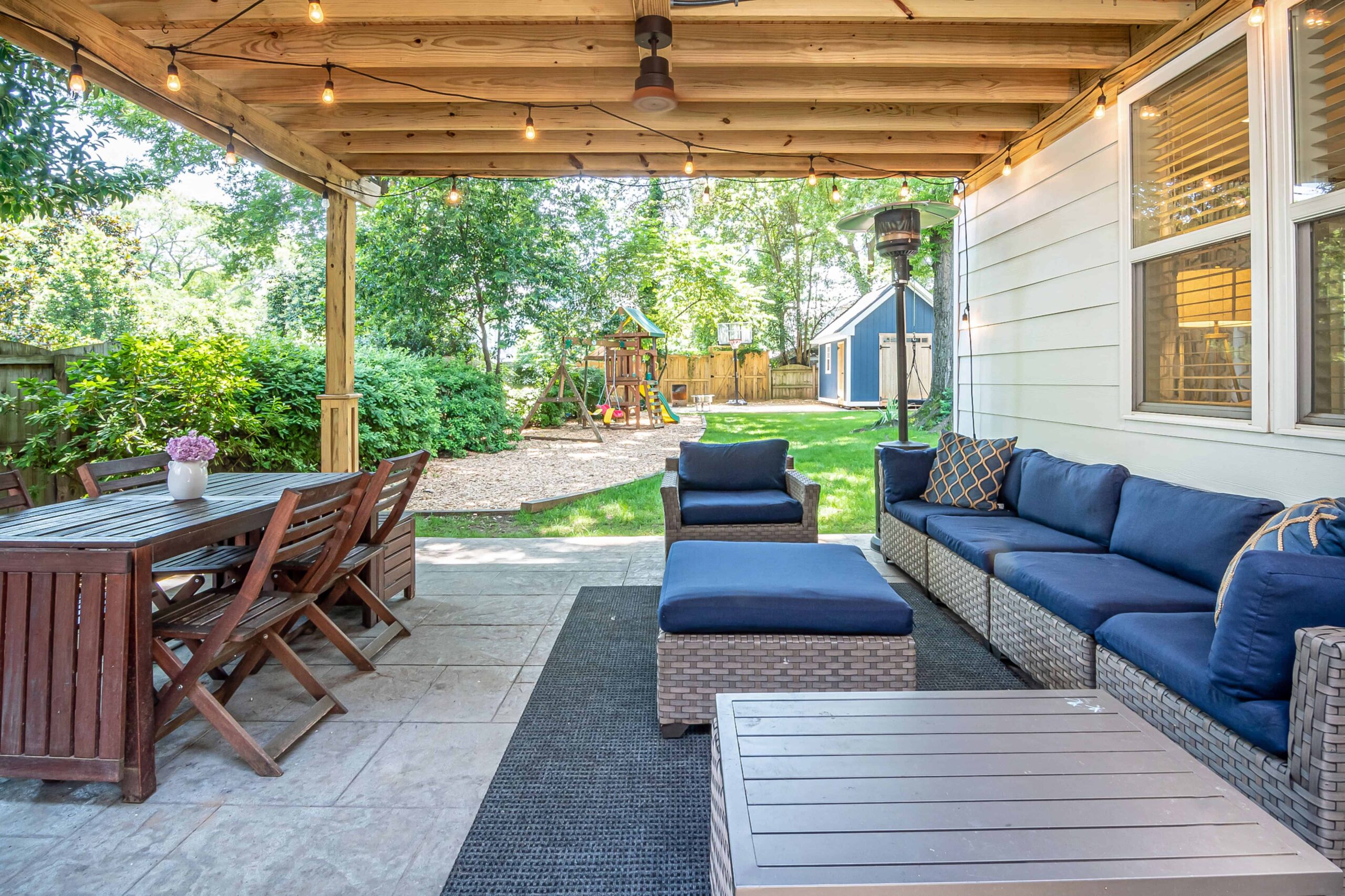
Most patios look fine on the day they are finished. The test is the fifth winter. By then the cheap ones have dropped at one corner, grown a green beard along the joints and started to rock under the table legs. The good ones look much as they did when the pointing was still wet. The difference is almost never the slabs. It is everything underneath them and around them.
The ground does the work
A patio is a thin skin over a lot of groundwork. The slabs might be 20mm thick. Beneath them should sit a full bed of mortar, then at least 100mm of compacted hardcore, then a sub-grade that has been dug out to firm ground rather than levelled across topsoil and builders’ rubble.
When a patio sinks, it is because the hardcore was thin, loose or laid over soil that was still full of air. When it rocks, it is because the slabs were spot bedded on five dabs of mortar instead of a full bed, leaving voids that fill with water and freeze. Both are invisible on completion day and both are the installer’s decision, not the homeowner’s.
Water has to leave
Every patio needs a fall of around 1 in 80, away from the house, towards a lawn, a border or a channel drain. Against a wall with no fall, rain sits against the damp-proof course and finds its way inside. Towards a fence with no outlet, you get a permanent puddle and a neighbour with a wet shed.
If the patio is larger than about 5 square metres and drains onto a hard surface rather than a garden, planning rules in England may require permeable construction or a soakaway. It is an easy conversation to have at the design stage and an expensive one afterwards.
Porcelain, sandstone or block
Porcelain has become the default for new patios and it earns its popularity. It does not absorb water, so it does not stain, frost or grow algae in the way natural stone does. It is also unforgiving. A porcelain slab laid on a weak bed will crack rather than sink, and it must be laid with a priming slurry or it will not bond at all. Installers who have only ever laid sandstone sometimes learn this on a customer’s garden.
Indian sandstone is still the warmest looking material and the most affordable per square metre. It needs sealing, it will change colour in its first year, and the cheaper grades vary in thickness so much that laying them to a true level is slow work. Buy from a supplier who can tell you which quarry it came from.
Block paving is the right answer when the patio joins a driveway or path, because it carries the same pattern through. It also allows for permeable construction more easily than slabs. Its weakness is weeds in the joints, which is a maintenance question rather than a quality one.
Joints are not an afterthought
The joints between slabs are where patios go wrong first. Sand brushed in looks neat for a month and then washes out. Traditional sand and cement pointing lasts well if it is done in dry weather and tooled properly, and fails quickly if it is slapped on in the rain. Resin jointing compounds cost more, cure hard, resist weeds and can be laid in damp conditions, which in this country matters.
Whichever is chosen, the joint should be at least 5mm wide for porcelain and 10mm for natural stone. Tight joints look sharp and crack within a year.
What the price is telling you
Patio quotes vary enormously, and the variation is almost always in the groundwork. A quote that is half the price of the others has usually saved it by digging out less, laying less hardcore and spot bedding the slabs. None of that shows in the photos.
When comparing patio installers in Essex, ask each one to state the excavation depth, the thickness of compacted sub-base, whether the slabs will be laid on a full bed, and what jointing they intend to use. An installer who answers those four questions without hesitating is one who has thought about the fifth winter.
Looking after it
A well-built patio needs very little. Natural stone wants resealing every two or three years. Porcelain wants a wash with a mild detergent. All of them want the joints checked each spring and any that have failed repointed before weeds take hold. A pressure washer used gently is fine; used hard, at close range, it strips the pointing out and starts the whole decline.
Build it properly, drain it properly and point it properly. The slabs are the easy part.