

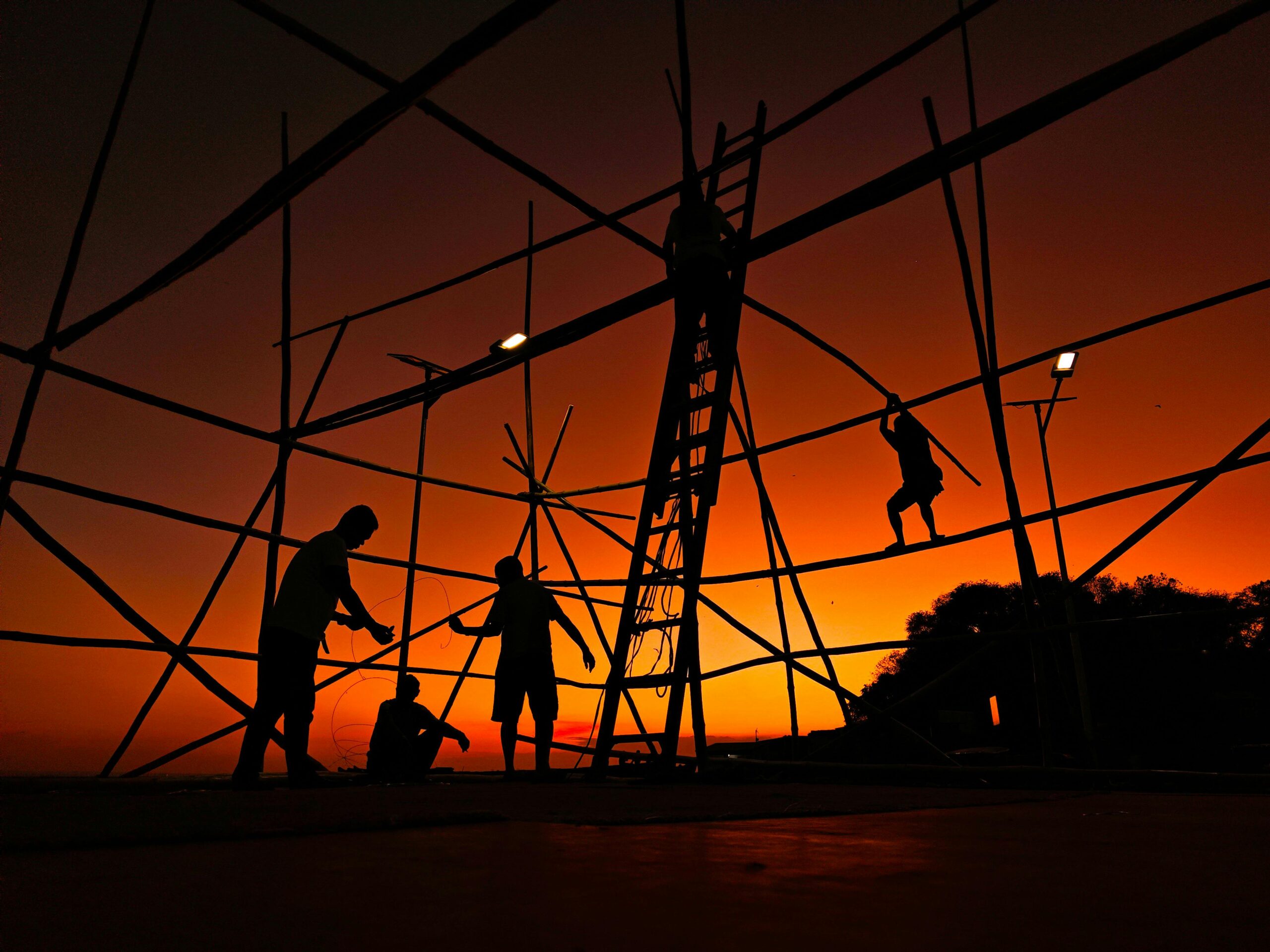
Some of the most important elements of a building project are never meant to last. They are installed with care, relied upon daily and then removed without ceremony once their role is complete. Scaffolding sits firmly in this category. Temporary by definition, yet essential in practice, it shapes how construction work unfolds long before the finished building takes its final form.
It is easy to overlook what is designed to disappear. Yet the quality of a build is often influenced by these temporary structures more than we realise. They create the conditions in which work happens, setting the tone for safety, pace and craftsmanship.
The paradox of temporary work
Temporary works occupy a curious position in construction. They must be strong, precise and dependable, yet they exist only to support something else. Their success is measured by how little attention they draw to themselves.
When scaffolding works well, it feels intuitive. Access is clear. Platforms are stable. Movement around the site feels natural rather than forced. This quiet reliability allows trades to focus on their work rather than the structure beneath them.
When it does not, the impact is immediate. Confidence falters. Time is lost. Attention shifts from quality to navigation. The temporary suddenly becomes the dominant concern.
Creating conditions for good work
Every trade relies on conditions that allow them to do their job properly. Light, space, stability and access all play a role. Scaffolding influences each of these elements, often more than any permanent feature of the site.
By providing consistent working levels and clear routes, scaffolding creates a sense of order. This order supports concentration. It reduces unnecessary movement and helps maintain rhythm throughout the day.
Good work rarely happens in chaotic environments. Temporary structures that are thoughtfully designed help establish the calm necessary for care and precision.
Safety as an outcome of design
Safety is often discussed in terms of rules and compliance. In reality, it is deeply connected to design. A well-considered scaffold reduces risk not through instruction, but through clarity.
People instinctively work more safely when their environment supports them. Stable platforms, logical access points and consistent surfaces reduce uncertainty. They allow workers to trust their footing and focus on the task at hand.
Even details such as the condition and placement of scaffolding Boards contribute to this sense of security, reinforcing the idea that safety is built into the site rather than imposed upon it.
The human experience of temporary structures
Construction is a collective effort. It depends on cooperation between people with different skills, responsibilities and pressures. Temporary works influence how these relationships function.
A site that is well supported by its scaffolding feels considered. It signals that thought has been given to how people will work together. This consideration often encourages respect between trades and smoother collaboration.
It is also why the basics matter. Reliable scaffolding supplies, delivered and organised with care, remove friction before it appears and help the site feel steady from the outset.
Supporting momentum
Momentum is one of the most valuable qualities on a building site. It is not about rushing, but about continuity. Work progresses steadily. Interruptions are minimal. Adjustments are manageable.
Temporary structures play a crucial role in maintaining this momentum. They allow work to continue across different phases without constant reconfiguration. They provide a stable framework within which change can occur.
When scaffolding adapts well to the evolving needs of a project, it supports progress rather than interrupting it. This adaptability is often the result of experience and foresight rather than standard solutions.
Temporary does not mean secondary
There is a tendency to treat temporary works as secondary to the main build. In practice, they are foundational. They influence how the permanent structure is realised and how the process is experienced.
Recognising this shifts how we value preparation and planning. It encourages investment in quality temporary structures, not as an afterthought, but as a core part of the project.
This perspective acknowledges that the journey matters as much as the destination. How a building is constructed affects not only its quality, but the people involved in creating it.
What remains after removal
When the scaffolding comes down, its absence is often taken as a sign of progress. The building stands on its own. Yet the influence of those temporary structures remains embedded in the work.
They shaped how carefully details were executed. They affected how safely people worked. They contributed to the overall rhythm of the project.
In this sense, scaffolding may be temporary, but its impact is lasting.
Why the temporary deserves attention
In a profession focused on results, it is easy to overlook what exists only to support them. Yet the success of a build is often rooted in these unseen elements.
Temporary structures deserve attention not because they are visible, but because they are vital. They create the environment in which quality becomes possible.
By recognising scaffolding as essential by nature rather than incidental by design, we gain a clearer understanding of what truly supports good building work.