
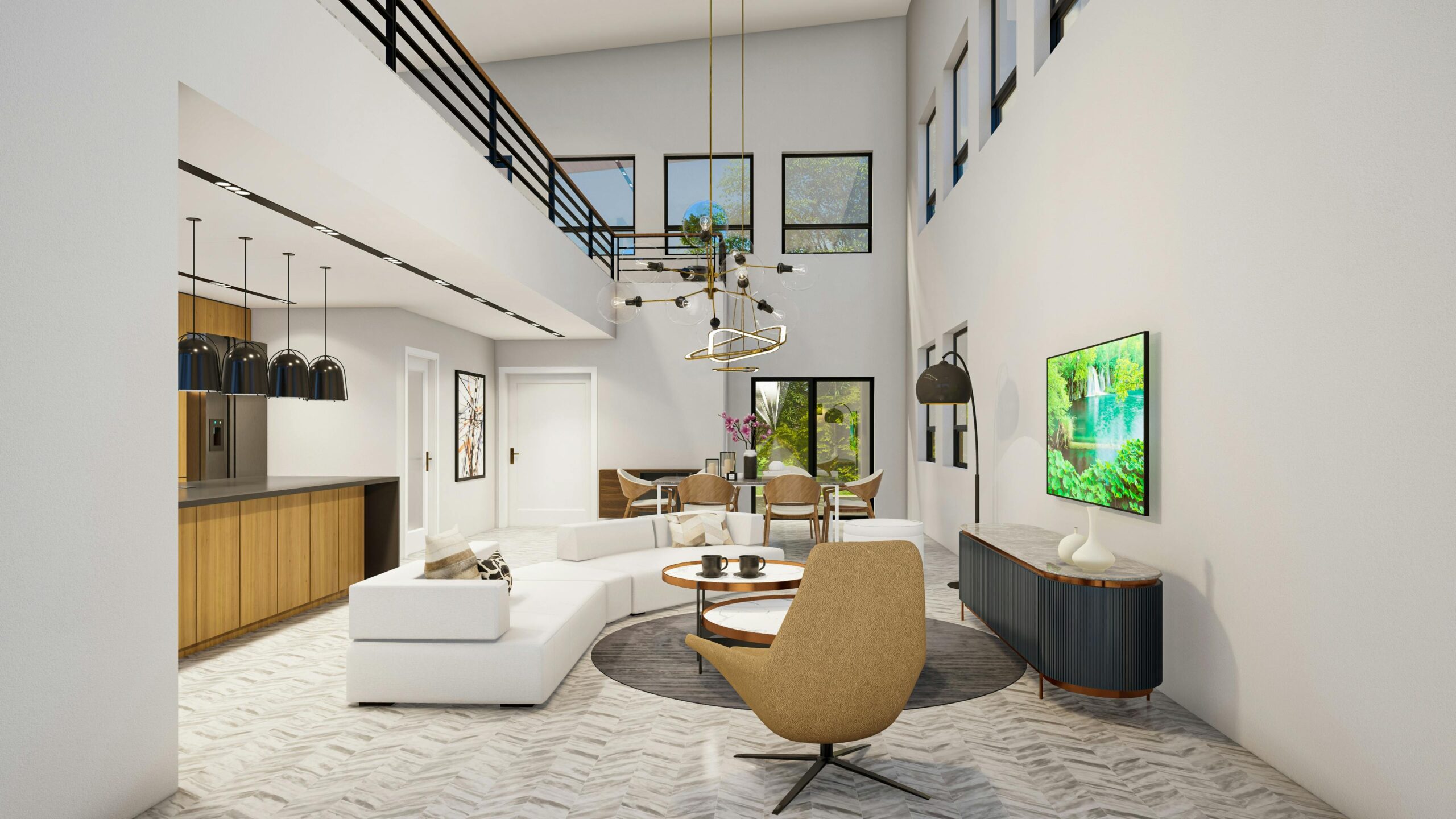
Austin-based architect spent three weeks last summer trying to convince a developer that terracotta tiles would clash with their brass fixtures. Sent paint samples, fabric swatches, lighting calculations. Developer wasn’t buying it. Then she rendered the space in 3D – took four hours, $800. Developer called back in twenty minutes. Tiles changed to limestone before the construction crew even broke ground.
That’s what 3D interior rendering does now. Not replace physical design – compress the time between concept and decision. Architects and interior designers build photorealistic digital versions of spaces that don’t exist yet, testing everything from furniture placement to how afternoon light hits a credenza before anyone orders materials or schedules contractors.
Why rendering replaced physical mockups faster than anyone expected
Physical staging used to be the only option. Furniture companies would set up entire rooms in warehouses – full-scale mockups with actual products, real lighting, hundreds of thousands in inventory just sitting there. A hotel chain I consulted for last year had 14 physical mockup rooms across three cities. Annual cost: $2.1 million just in warehouse space and furniture that couldn’t be sold because it had been moved around too much.
Interior visualization software changed that math completely.
Rendering engines handle physically accurate light behavior now. Subsurface scattering – light penetrates a surface, bounces around inside the material, exits somewhere else. You see it in marble, translucent fabrics, polished wood. V-Ray and Corona Renderer calculate millions of light paths per frame, simulating how photons actually behave. A velvet sofa in afternoon sunlight looks like velvet in afternoon sunlight because the renderer is mathematically modeling light absorption and reflection at the fiber level.
CGI Artists can iterate 40-50 material variations in the time it takes to order and install one physical sample. Portland designer tested 47 different backsplash tiles for a kitchen project – total time: two days, including client reviews.
But cost isn’t why companies switched. It’s timelines.
Traditional photography requires finished spaces. Construction has to be complete, furniture installed, styling finished. If the client hates something after seeing photos, you’re looking at change orders, delays, contractor callbacks. One residential developer in Seattle told me they used to budget 6-8 weeks between construction completion and marketing launch just for photography and inevitable adjustments. With 3D rendering, they start marketing before foundation is poured. Same developer sold 60% of units pre-construction last year versus 12% the year before.
Here’s the thing – rendering isn’t faster because computers are fast. It’s faster because you can make decisions earlier. Materials, layouts, color schemes get locked down when they’re still cheap to change. A colleague switched a kitchen from marble to quartz countertops after seeing the render – would’ve been a $18,000 change order if they’d caught it after installation. In the 3D model, it was forty minutes of work.
Technical details that separate photorealistic from obviously fake
The difference between good rendering and great rendering is in things most people don’t consciously notice. Imperfections, mostly.
Real furniture has wear patterns. Dining chair arms get shinier where hands grip them. Leather develops creases in specific spots based on how people sit. Hardwood floors near windows fade differently than floors under area rugs. Professional rendering artists spend hours adding these details – slightly misaligned books on shelves, asymmetrical cushion compression, dust particles visible in light beams. A Chicago studio I worked with has a library of 2,000+ imperfection textures: scratches, scuffs, watermarks, fabric pills. They layer them onto 3D models the way a set designer would weather a prop.
Lighting is where most renderings fail.
Natural light changes color temperature throughout the day. Morning light at 7 AM is cooler, bluer – about 5,500 Kelvin. Late afternoon drops to 3,500K, much warmer and orange. Most amateur renderings use static lighting, same color temperature regardless of time simulation. Professional interior rendering calculates sun position based on geographic location and time of day, adjusting both intensity and color. They also add light bounce – when sunlight hits a red wall, it casts subtle red tones onto nearby white surfaces. Global illumination algorithms handle this, but it requires proper setup. Furniture designer spent six hours on one camera angle – moved it 2.3 degrees, everyone signed off. $1,200 for two point three degrees.
Camera settings matter more than people think. Real cameras have depth of field – background goes soft when you focus on foreground objects. Lens distortion affects how straight lines appear, especially at edges of wide-angle shots. Professional renderers match virtual cameras to actual DSLR specifications: focal length, aperture, ISO, even lens manufacturer characteristics. Canon glass renders slightly warmer than Nikon glass. These details don’t consciously register with viewers, but their absence makes images feel wrong in ways people can’t articulate.
According to McKinsey 2023 research, 61% of furniture manufacturers now produce marketing materials before final product prototypes exist, using visualization to test market reception and adjust designs before manufacturing.
How designers actually use rendering in project workflows
Most architecture firms now render at three stages. Concept phase uses lower-quality renders – enough detail to communicate spatial relationships and general aesthetic, but not photorealistic. Mid-project renders get more detailed as material selections narrow down. Final renders are full photorealistic quality for client presentations and marketing.
The workflow splits into two tracks: design iteration and client communication. Design iteration happens in real-time – architects move furniture around in 3D space, adjust wall colors, test different lighting fixtures, all while viewing simplified renders that update in seconds. Client communication uses overnight renders – high quality but slow, sometimes 4-6 hours per image on render farm servers. Those are the images that end up in presentations and marketing materials.
Residential interior designers use rendering differently than commercial firms. Residential projects involve fewer stakeholders – usually just the homeowner and maybe a spouse. Renders focus on emotional impact: how the space will feel, specific lifestyle scenarios. Commercial rendering emphasizes functionality and brand alignment. Hotel chains want to see how 200 identical rooms will look with slight variations. Office developers need to show flexible layouts that accommodate different tenant needs.
Material libraries are crucial. Professional rendering studios maintain databases of scanned materials – actual fabric, wood, stone, metal samples photographed under controlled lighting. These scans capture surface texture, reflectivity, and color more accurately than manually created materials. One textile company scanned their entire catalog: 3,400 fabric patterns, each photographed at multiple angles with different lighting. That library cost them $89,000 to create but saves weeks on every project that uses their products.
Real estate developers report different metrics. Toll Brothers tracked this – properties with 3D interior rendering in listings got 47% more inquiries than properties with traditional photography, according to their 2024 sales data. But more interesting: buyers who viewed renders before visiting in person were 28% more likely to make offers. The renders pre-qualified buyers – they already knew what they were getting, showed up with fewer surprises, made faster decisions.
Some technical considerations:
- Polygon count affects render time exponentially – a high-detail sofa with 400,000 polygons takes 16x longer to render than a simplified 25,000 polygon version that looks nearly identical in final images. Professional modelers optimize geometry, using detail only where cameras will see it.
- Texture resolution needs to match viewing distance – 4K textures for close-up shots, 1K sufficient for background elements. A bedroom render might use 8K resolution for the bed linen in focus, 512px textures for artwork visible through a doorway in the background.
- Render engines handle transparency differently – glass, sheer curtains, translucent materials require more computational power. A room with floor-to-ceiling windows might take three times longer to render than an identical space with solid walls.
The cost structure confuses people. Rendering isn’t priced per image – it’s priced per project complexity. Simple bedroom with standard furniture: $800-1,500 for three views. Luxury penthouse with custom furniture, complex lighting, city views through windows: $8,000-15,000 for the same three images. The difference is modeling time, not rendering time. Once the 3D scene exists, additional camera angles are relatively cheap – maybe $400-600 each versus the thousands spent building the initial model.
Manhattan designer told me she renders everything twice now. Once at actual scale, once at 15% larger. Shows both to clients without telling them which is which. Clients almost always prefer the oversized version – makes spaces feel more luxurious, furniture more substantial. She uses the accurate version for contractor drawings, oversized for marketing. It’s technically deceptive but apparently everyone does it.
Rendering speeds improved 340% between 2020 and 2024 due to GPU optimization and AI-assisted denoising algorithms, according to Chaos Group benchmark data. What took overnight now finishes during lunch.
Virtual reality integration is the next evolution. Clients put on VR headsets, walk through rendered spaces at full scale. You can see how ceiling height feels, whether the kitchen island is too close to the refrigerator, if the TV viewing distance is comfortable. It changes decision-making – abstract concepts become visceral experiences. One client approved a $2.3 million renovation after 15 minutes in VR that she’d been debating for four months from 2D renders and floor plans.
The industry still has limitations. Rendering can’t show how materials age, how spaces smell, acoustics, how air flows through rooms. A beautifully rendered restaurant might have terrible acoustics in reality. Kitchen rendering shows gleaming appliances but can’t demonstrate workflow inefficiencies. These gaps matter more in commercial projects where functionality trumps aesthetics.
But for what it does – showing spaces before they’re built, testing design decisions cheaply, communicating vision to clients who can’t read floor plans – 3D interior rendering replaced most traditional methods without much debate. The Austin architect with the terracotta tiles now renders every project before presenting to clients. Hasn’t had a major design argument in two years.